Why the Same Walk Feels Different in September
Quick Answer: Cooler air genuinely makes walking feel easier at the same pace, because your body spends less energy on cooling and heart rate drops for the same effort. It also makes the first five minutes feel stiffer, because muscles start colder. If your familiar walk feels harder rather than easier, the usual explanations are less daily movement overall, darker conditions changing your pace unconsciously, or the shoes you switched to.
The route has not changed. The distance has not changed. And it feels completely different from how it felt six weeks ago.
Some of that is measurable physiology. Some of it is the light. Both are worth knowing.
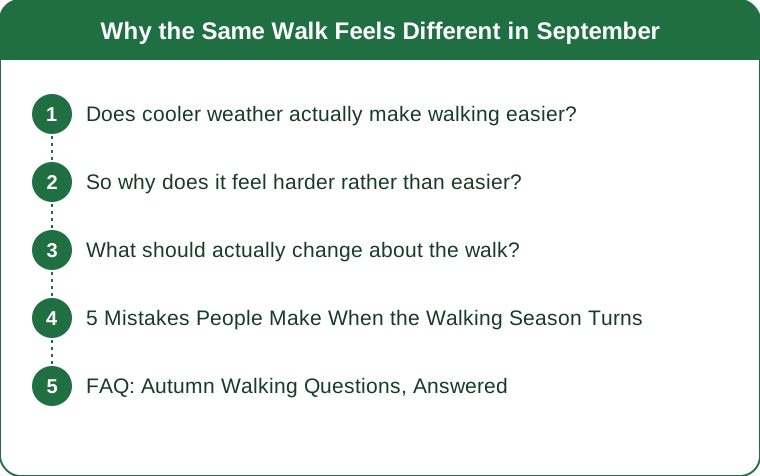
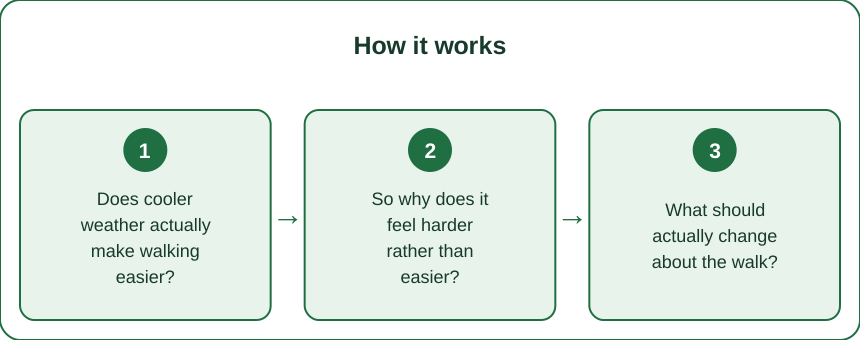
Does cooler weather actually make walking easier?
Yes, and the mechanism is straightforward.
In hot weather, a significant share of your cardiovascular output goes to cooling. Blood is directed toward the skin to dissipate heat, which means less is available for working muscle. The result is a higher heart rate at the same pace - a well-documented effect known as cardiovascular drift, which is more pronounced in heat.
When the air cools, that cooling demand drops. Heart rate at a given walking pace falls, perceived effort falls, and the same route genuinely requires less of you. This is why autumn tends to produce personal bests in running and walking events.
The comfortable range for most people is broadly between roughly 10 and 20 degrees Celsius for sustained walking - cool enough to shed heat easily, warm enough not to require heavy layers.
Humidity matters as much as temperature. Sweat cools you by evaporating, and high humidity slows evaporation. A late summer day at 24 degrees and 80% humidity is harder work than 28 degrees and 40% - which is why the first genuinely dry autumn day can feel dramatic.
What gets harder rather than easier:
- The first five minutes, because muscles start colder and blood flow to the extremities is reduced
- Breathing in genuinely cold air, for some people, particularly with asthma
- Getting out of the door, which is not physiological but is the main reason walks stop happening
The practical version: allow a longer, gentler start and expect the middle of the walk to feel better than it did in August.
So why does it feel harder rather than easier?
Four common reasons, and none of them are fitness loss.
Your baseline daily movement dropped. Incidental movement falls in autumn - fewer outdoor errands, less time in the garden, more time indoors. If the daily walk was previously one component among several and is now doing more of the total, it feels like more work because your legs are less pre-warmed and your general activity level is lower.
You are walking in different light, and pacing differently. In lower light, people tend to walk more cautiously, particularly on uneven ground. A slightly shorter stride at a slightly higher cadence feels different even at the same overall speed. On a genuinely dark route, attention shifts to footing, which changes the whole quality of the walk.
You changed shoes. The switch from summer to autumn footwear is easy to overlook, and it changes everything about how a walk feels. A heavier boot, a stiffer sole, or a shoe you have not worn in months all alter gait and effort.
You are wearing more. Extra layers add weight and restrict movement slightly, and overdressing produces the same overheating problem you were escaping. The classic mistake is dressing for how it feels standing at the door, rather than for how it will feel ten minutes in.
The rule of thumb worth adopting: dress so you are slightly cool for the first five minutes. If you are comfortable at the door, you will be too warm by the middle.
One more possibility worth checking: if the walk also feels harder on flat indoor surfaces, then it is not the season and something else has changed - sleep, illness, or training load are the usual candidates.
What should actually change about the walk?
Three adjustments, all small.
Extend the warm-up portion. Start at a genuinely easy pace for the first five minutes rather than setting off at your usual speed. Cold muscles have reduced blood flow and elasticity, and the ramp matters more than it did in summer.
Consider adding a little duration. Because incidental movement falls in autumn, the deliberate walk is carrying more of your total. Adding five to ten minutes maintains your overall activity without needing more effort per minute.
Adjust the route for light and surface. A route that was pleasant in daylight can be genuinely unpleasant in the dark, and wet leaves are more slippery than most people expect. Having a designated darker-months route - better lit, better surfaced - keeps the habit going when the original route stops working.
On visibility: if any part of your walk is on or near roads in low light, something reflective is worth wearing. It is a small thing that becomes relevant quickly as the evenings draw in.
What not to change: the frequency. Consistency is what makes walking work, and the most common autumn pattern is reducing frequency while trying to make each walk more substantial. The reverse is more durable - keep the frequency, let individual walks be shorter on bad days.
One optional addition: if you want more from the same walk without adding time, a hill or a stretch of brisker pace in the middle does more than adding distance. Cool air makes that far more tolerable than it was in August.
5 Mistakes People Make When the Walking Season Turns
1. Overdressing. The single most common one. Dressing for standing-still comfort means overheating by minute ten, and sweat in cool air then makes you cold for the rest of the walk. Dress to be slightly cool at the start.
2. Keeping the same route into the dark months. A route that relies on daylight for safety or pleasantness will quietly stop being used. Choosing a better-lit alternative in advance beats abandoning the habit in November.
3. Reducing frequency to preserve duration. Three long walks a week is more fragile than six short ones when conditions are working against you. Frequency is the thing to protect.
4. Ignoring the shoe change. New or different autumn footwear changes gait, effort and comfort, and it accounts for a surprising number of complaints about a familiar walk suddenly feeling wrong. Break in autumn shoes on short walks first.
5. Not adjusting hydration. You sweat in cool weather too, and thirst is a weaker signal when you are not hot. Under-drinking on autumn walks is common and produces exactly the vague heaviness people attribute to the season.
FAQ: Autumn Walking Questions, Answered
Should I walk faster in cooler weather?
You probably will, without deciding to - cooler air lowers heart rate at a given pace, so your natural comfortable pace tends to rise. There is no need to force it. Just allow a longer easy start.
Is it bad to walk in cold air?
For most people, no. Some find cold air irritating to the airways, particularly with asthma - breathing through the nose or wearing a light buff over the mouth warms and humidifies the air and generally resolves it.
Do I burn more calories walking in the cold?
Slightly, if you are cold enough to shiver or your body is working to maintain temperature. In practice, once you are moving and dressed appropriately the difference is small. It is not a meaningful reason to underdress.
Why do my hands and feet get cold on autumn walks when the rest of me is fine?
Blood flow is prioritised to the core in cool conditions, so extremities cool first. Gloves and proper socks address it more effectively than adding a heavier coat.
How do I stay consistent when it is dark?
Decide the darker-months version of the route in advance, and set the walk earlier in the day if your schedule allows. The habit usually breaks because the setup is adjusted reactively, weeks after the conditions have already changed.
TL;DR:
- Cooler air genuinely lowers heart rate at the same pace, so the middle of the walk should feel easier
- The first five minutes feel harder because muscles start colder - extend the easy portion
- If the whole walk feels harder, check for reduced daily movement, darker pacing, new shoes, or overdressing
- Dress to be slightly cool at the door; comfortable at the door means overheated by minute ten
- Protect frequency over duration - short walks done often survive the season change
- Choose a well-lit autumn route before you need it, not after you have stopped going
The walk did not get harder. Roughly four small things changed at once, and all of them are adjustable.
See It in Motion
Seen here: Super High Waist Embossed Yoga Leggings with Inner Pocket — shop it on bubblelime.com
Keep Reading
This article is for general informational and styling purposes only. Fit, sizing, and product availability may vary.