Walking Before or After Dinner: Does the Timing Actually Matter?
Quick Answer: After dinner wins for metabolic benefit, and the effect is unusually well established. Walking within about 30 minutes of eating meaningfully blunts the post-meal blood glucose rise, because working muscle takes up glucose without needing extra insulin. Even 10 to 15 minutes helps. Walking before dinner is better for appetite regulation and for actually doing it consistently, and it is the better choice if eating then walking gives you reflux or discomfort. If you want one rule: 10 minutes after, longer before, and the one you will actually repeat beats the theoretically optimal one.
Most exercise timing questions have annoyingly soft answers. Morning versus evening training, fasted versus fed - the honest response is usually that the difference is small and adherence matters more.
This is one of the exceptions. The post-meal walk has a specific, measurable, well-replicated effect, and the timing window is genuinely narrow.
Which makes it worth knowing precisely, rather than walking whenever and assuming it evens out.

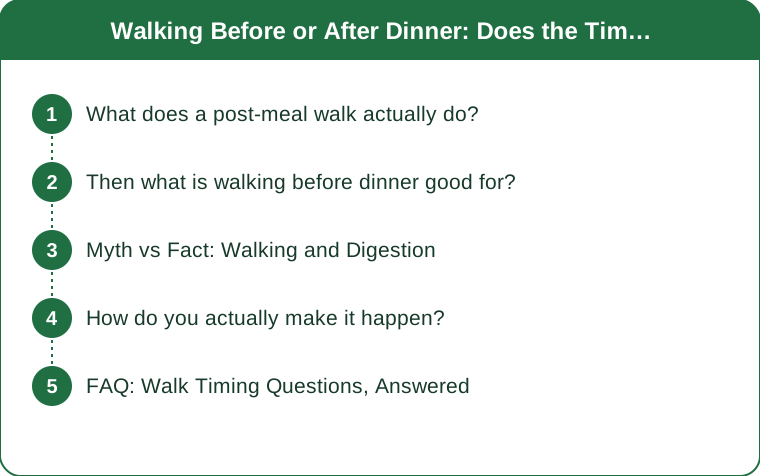
What does a post-meal walk actually do?
It gives glucose somewhere to go that does not require insulin.
After a meal containing carbohydrate, blood glucose rises and the pancreas releases insulin to move it into cells. That is normal. What varies enormously between people and situations is how high the peak goes and how long it stays there - and repeated large excursions are associated with worse metabolic health over time, independent of average blood sugar.
Walking intervenes through a genuinely separate mechanism. Contracting muscle takes up glucose via insulin-independent transport - the muscle pulls glucose out of the blood because it is working, not because insulin told it to. So you get glucose clearance without additional insulin demand.
The effect sizes reported in the literature are consistently meaningful. Short post-meal walks reduce post-meal glucose excursions substantially compared with sitting, and studies comparing short walks after each meal against one longer daily walk have generally favoured the distributed post-meal version for glucose control.
Three practical details that matter:
- The window is roughly 30 minutes after eating, ideally starting within 15. Wait 90 minutes and you have largely missed the peak.
- Intensity barely matters. Easy walking is enough. This is not a workout and treating it like one adds nothing.
- Duration saturates fast. Ten to fifteen minutes captures most of the benefit. Forty-five minutes is a nicer evening, not a substantially better glucose response.
The dinner meal is usually where this matters most, because it is typically the largest meal and it is followed by the most sitting.
Then what is walking before dinner good for?
Genuinely different things, and some of them may matter more to you.
Appetite regulation. Moderate activity before a meal tends to modestly blunt appetite rather than sharpen it, which runs against the common assumption that exercise makes you ravenous. A pre-dinner walk can take the edge off the specific 5pm hunger that leads to eating while cooking.
The transition function. A walk between the working day and the evening is a psychological boundary, and this is a real benefit rather than a soft one. For anyone working from home, where there is no commute to end the day, it may be the single most valuable thing the walk does.
Reliability. A pre-dinner walk is scheduled around a fixed event you were going to do anyway. A post-dinner walk competes with the couch, and the couch usually wins - especially as evenings get darker, which they are noticeably doing now.
Comfort. Some people simply cannot walk comfortably after eating. Reflux, fullness, cramping - if that is you, the metabolic argument is irrelevant because you will not do it.
Light exposure. In late August, a 6pm walk still gets you real daylight and a 8:30pm one increasingly does not. Evening light exposure has its own effects on circadian timing, and as the season turns the pre-dinner slot is where the daylight is.
So the honest framing is not that one is right. It is that they do different jobs, and the after-dinner one has the clearer metabolic case while the before-dinner one has the clearer adherence case.

Myth vs Fact: Walking and Digestion
Myth: Walking after eating interferes with digestion. Fact: Easy walking does not divert meaningful blood flow away from the gut, and it tends to modestly speed gastric emptying rather than slow it. The advice to rest after eating applies to hard exercise, not to a stroll around the block.
Myth: You need to wait 30 minutes to an hour before walking. Fact: For a gentle walk this waiting period actively works against you, because it puts you outside the window where you would blunt the glucose peak. Starting within 15 minutes is closer to ideal. For vigorous exercise, waiting is sensible - but that is a different activity.
Myth: A long walk once a day beats short walks after meals. Fact: For post-meal glucose specifically, several studies have found the distributed version performs better. For total activity and cardiovascular fitness, the long walk is fine. Different outcomes, different answers.
Myth: It only matters if you have diabetes. Fact: Post-meal glucose excursions occur in everyone, and reducing them appears to be broadly beneficial rather than only clinically relevant. It matters more if you have diabetes or insulin resistance - but not exclusively.
Myth: You have to walk fast for it to count. Fact: This is the most common way people accidentally opt out. Easy, conversational walking produces most of the effect. The muscle contraction is doing the work, not the intensity.
Myth: Standing is just as good. Fact: Better than sitting, clearly worse than walking. Standing involves minimal muscular contraction, and contraction is the mechanism.
How do you actually make it happen?
The honest obstacle is that after dinner is the least motivated part of the day, and it is getting darker earlier every week from here.
Set the bar at 10 minutes, not 30. Ten minutes captures most of the metabolic benefit and, crucially, it is short enough that you cannot really argue with it. The most common failure mode is setting a 40-minute standard and doing it twice.
Attach it to clearing the table, not to a time. Event-anchored habits survive schedule changes; time-anchored ones do not, and everyone’s evening schedule is about to change with the school year.
Walk with whoever you ate with. Post-dinner walks have the highest social compliance of any form of exercise, because it does not feel like exercise. Two people who both said no separately will often both say yes together.
Have a fixed route. Deciding where to go is friction, and friction at 8pm is fatal. One loop, always the same, no decisions.
Fix the darkness problem now rather than in October. A reflective layer and a light by the door, in August, before the evening you first notice it is dark. This is the single most common reason evening walk habits die in autumn, and it is entirely preventable.
And when it genuinely does not happen, walk before dinner instead. A pre-dinner walk you actually do is worth far more than a post-dinner one you keep intending to.
FAQ: Walk Timing Questions, Answered
How soon after eating should I start walking?
Within about 15 minutes is ideal, and within 30 still captures most of the benefit. Blood glucose typically peaks somewhere around 30 to 60 minutes after a meal, so the goal is to be moving as it rises rather than after it has come back down. Waiting an hour is not harmful, it just makes it an ordinary walk rather than a post-meal one.
Is 10 minutes really enough to matter?
For blunting the post-meal glucose rise, yes - short walks in the 10 to 15 minute range show a clear effect in the research, and the returns flatten well before 30 minutes. For general fitness and cardiovascular health, no, 10 minutes a day is not a complete activity plan. It is a specific tool for a specific job.
What if walking after eating gives me reflux?
Then walk before dinner and stop optimising for the wrong variable. Reflux is worse when you are upright and moving with a full stomach for some people, and no metabolic benefit is worth an evening of discomfort. You can also try a smaller dinner with a walk after, or walking after lunch instead, where the same mechanism applies.
This is general information, not medical advice. If you are managing diabetes or taking glucose-lowering medication, talk to your healthcare team before changing activity timing around meals.
TL;DR:
- After dinner wins on metabolism. Walking within 30 minutes of eating meaningfully blunts the glucose peak via insulin-independent muscle uptake.
- 10 to 15 minutes captures most of it. Longer is nicer, not much more effective.
- Intensity does not matter. Easy walking works, and treating it as a workout is the fastest way to stop doing it.
- Before dinner wins on appetite, daylight, and actually happening - which is not a small consideration.
- Sort out the reflective layer and the light now, in August, not the first dark evening in October.
This is one of the rare timing questions with a real answer. But the real answer still loses to the walk you actually take, so pick the slot that survives your evenings.
See It in Motion
Seen here: High Waist Yoga Leggings with Inner Pocket — shop it on bubblelime.com
Keep Reading
This article is for general informational and styling purposes only. Fit, sizing, and product availability may vary.