Why the Same Evening Walk Feels Harder Than the Morning One
Quick Answer: Evening walks feel harder mainly because of accumulated heat load, mild dehydration built up across the day, and lower blood sugar before dinner - not because your fitness dropped. Core temperature also peaks in the late afternoon, so you start the walk warmer. Drinking 12 to 16 ounces an hour beforehand and eating something small usually closes most of the gap.
The same 40-minute loop that felt easy at 7am feels like work at 6pm, and the number on your watch says you did not go faster. There are good reasons for that.

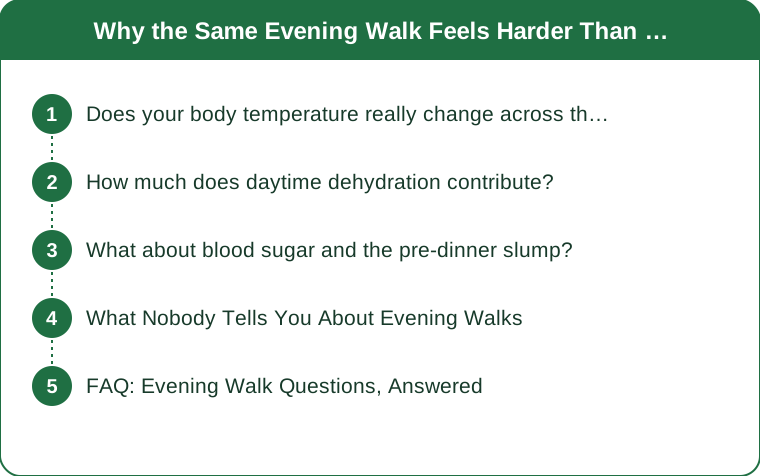
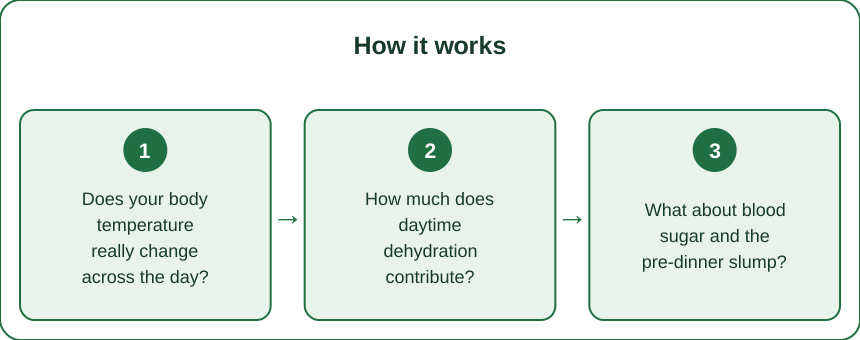
Does your body temperature really change across the day?
Yes, and by more than people expect. Core temperature follows a circadian rhythm with a low point in the early morning hours and a peak in the late afternoon to early evening - a swing of roughly 1F for most people.
That means an evening walk starts from a warmer baseline. Add ambient heat that has been building since noon and radiant warmth still coming off pavement, and the total thermal load is meaningfully higher.
Higher thermal load raises heart rate at a given pace and raises perceived effort, which is exactly the sensation people describe.
How much does daytime dehydration contribute?
A lot, and it is the most fixable factor. Most people finish a workday down half a liter to a liter and a half, especially in summer with air conditioning pulling moisture out of the air.
Even mild dehydration around 2 percent of bodyweight raises heart rate, reduces plasma volume and increases perceived effort noticeably.
The practical version: drink 12 to 16 ounces in the hour before an evening walk, and check that urine is pale rather than dark. That one habit changes the experience more than any pacing strategy.

What about blood sugar and the pre-dinner slump?
The 5pm to 7pm window is often the longest stretch since the last real meal. Blood glucose sits at its lowest point of the day for many people, and the resulting drop in perceived energy gets attributed to fitness or willpower.
A small snack 30 to 45 minutes before - a piece of fruit, a handful of nuts, yogurt - is usually enough. This is not about fueling a hard workout; it is about not starting a 40-minute effort at the bottom of the daily energy curve.
Mental fatigue from a full workday is real too. Cognitive fatigue measurably increases perceived physical exertion even when actual performance is unchanged.
What Nobody Tells You About Evening Walks
Here is the reversal: for most people the evening walk is physiologically the better performance window, not the worse one. Muscle temperature, joint mobility, reaction time and strength all peak in the late afternoon.
What feels harder is not producing less - it is producing the same output with more heat and less fluid in the tank.
The second surprise is that evening walks tend to be more consistent long-term for people with variable morning schedules, because the day’s obligations are done. The morning walk feels better and gets skipped more often.
And the third one: an evening walk that ends 90 minutes or more before bed genuinely improves sleep onset, while one that ends 20 minutes before bed delays it. Same walk, opposite effect, decided entirely by timing.
FAQ: Evening Walk Questions, Answered
Should I switch to morning walks instead?
Only if mornings actually happen for you consistently. The best walk is the one you take, and evening physiology is favorable once you handle heat and hydration.
How long before bed should I finish?
Aim for 90 minutes or more in hot weather so core temperature has time to come down. A cool shower afterward speeds that up.
Why is my heart rate higher on the same route in the evening?
Higher starting core temperature, ambient heat and accumulated fluid deficit all raise heart rate at the same pace. It is thermal drift, not lost fitness.
TL;DR:
- Core temperature peaks in the late afternoon, so evening walks start warmer and feel harder.
- Accumulated daytime dehydration is the biggest fixable factor - drink 12 to 16 ounces in the hour before.
- A small snack 30 to 45 minutes ahead handles the pre-dinner blood sugar dip.
- Evening is actually the stronger performance window; it just costs more perceived effort in summer.
The route did not get longer and you did not get slower. Handle the heat, the fluid and the snack, and the evening loop goes back to feeling like the morning one.
See It in Motion
Seen here: High Waist Yoga Leggings with Side Pockets — shop it on bubblelime.com
Keep Reading
This article is for general informational and styling purposes only. Fit, sizing, and product availability may vary.