Why Your Daily Walk Stopped Feeling Like Exercise (and What to Change)
Quick Answer: A walk that no longer feels challenging usually means your cardiovascular fitness genuinely improved and the same pace now sits below your training threshold — the fix is adding incline, pace intervals, or load (a weighted vest or backpack), not necessarily more time.
It’s a good problem to have, but it’s still a problem if the goal was fitness, not just movement: a walk that stopped challenging you has largely stopped improving you.

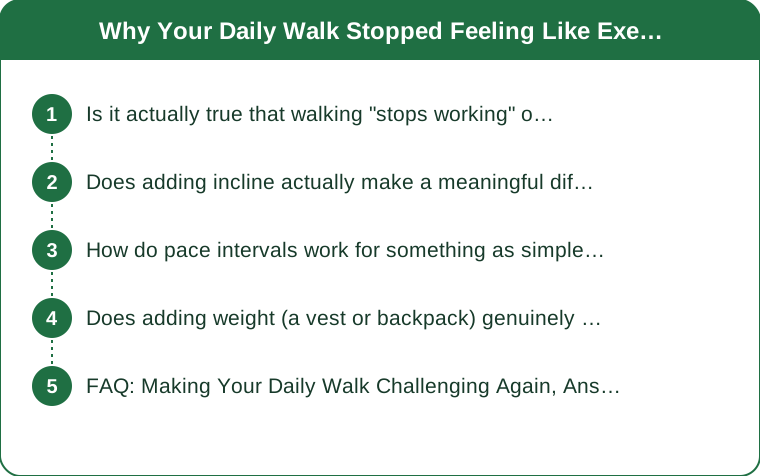
Is it actually true that walking “stops working” once it gets easy?
Cardiovascular and muscular adaptation is specific to the stimulus applied — once your body adapts to a given pace and terrain, that same walk maintains fitness rather than building it further, which is genuinely fine for general health but won’t continue improving cardiovascular capacity or burning the same relative calories it once did.
Does adding incline actually make a meaningful difference?
Yes, disproportionately so — a 5-10% incline can roughly double the calorie burn and cardiovascular demand of the same walking speed on flat ground, because it recruits the glutes and calves far more heavily and elevates heart rate without needing to walk faster. This is one of the most efficient ways to re-challenge a walk without adding time.

How do pace intervals work for something as simple as walking?
Alternating 2-3 minutes of your normal pace with 1-2 minutes of a noticeably faster “power walk” pace repeated throughout the walk creates the same interval-training cardiovascular benefit used in running and cycling — the body responds to the variation in intensity, not just the average speed, so intervals can make a walk challenging again even at the same total duration.
Does adding weight (a vest or backpack) genuinely add training benefit?
A weighted vest (typically 5-15% of body weight, added gradually) increases the muscular and cardiovascular load of the same route, essentially raising the ceiling of what “easy” pace demands — it’s a legitimate progression method used in rucking and hiking training, though it should be added gradually to avoid joint strain, particularly for the knees on downhill sections.
FAQ: Making Your Daily Walk Challenging Again, Answered
Should I just start running instead if walking has gotten too easy?
Running is one valid option, but it’s a much bigger jump in impact and injury risk — incline, intervals, or added weight let you progress walking’s benefit without that jump, and can be combined with occasional running if that’s a goal.
How do I know if my walk is actually too easy versus just feeling easy that day?
A rough gauge: if you can hold a full conversation with zero effort for your entire walk, most days, it’s likely below a training-effective intensity — some breathlessness during at least part of the walk is a reasonable target.
Is a longer walk at the same easy pace just as good as a shorter, harder one?
Both have value depending on the goal — longer easy walks support general health, recovery, and step count, while harder shorter walks build cardiovascular fitness more efficiently; many people benefit from a mix of both across the week.
TL;DR:
- A walk feeling easy usually means real fitness improvement, not a failure of walking as exercise
- Incline adds cardiovascular demand more efficiently than adding time
- Pace intervals re-challenge a walk without changing the route or duration
- A weighted vest, added gradually, raises the ceiling of what your normal pace demands
An easy walk isn’t wasted — but if fitness is the goal, it’s worth making it work again.
See It in Motion
Seen here: Yoga Jogger Sweatpants with Pockets — shop it on bubblelime.com
Keep Reading
This article is for general informational and styling purposes only. Fit, sizing, and product availability may vary.