Why Your Daily Walks Stopped Producing Results, and 4 Ways to Fix It
Quick Answer: Walking plateaus almost always come from your body adapting to a fixed pace, distance, and route — the same walk that used to challenge you now requires less effort. Changing incline, pace intervals, or added load resets the challenge without needing to walk longer.
Six months ago, your daily walk left you a little breathless and clearly did something. Now it feels like background noise — pleasant, but not challenging. That’s not a sign walking stopped working; it’s a sign your body adapted to the specific stimulus you’ve been repeating.

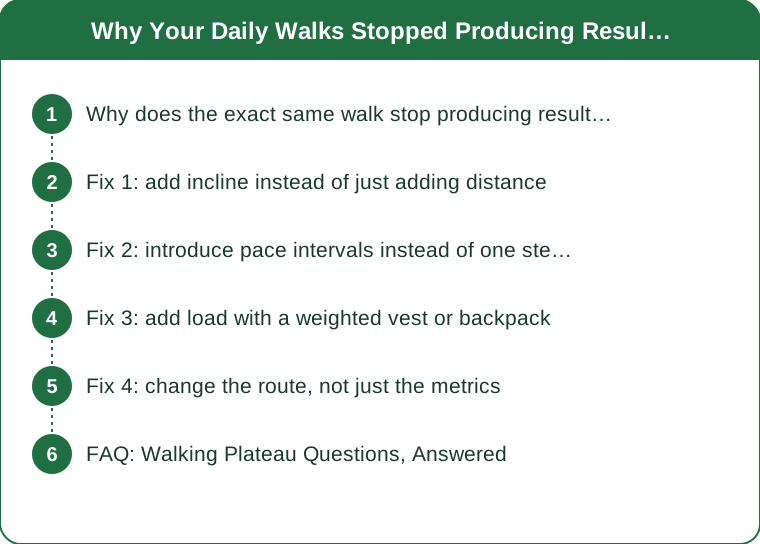
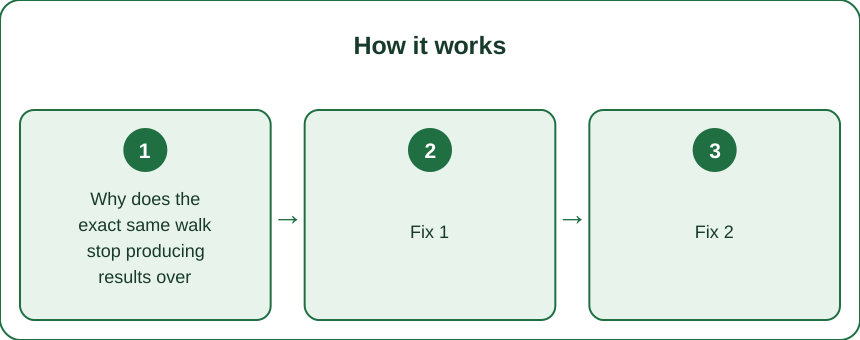
Why does the exact same walk stop producing results over time?
Your cardiovascular system and muscles adapt to repeated, predictable stress — this is a normal and actually healthy adaptation, but it means a walk that was challenging at month 1 requires proportionally less effort by month 6 at the identical pace and route.
This isn’t unique to walking — it’s the same adaptation principle behind why any repeated exercise eventually plateaus without some form of progressive change.
Fix 1: add incline instead of just adding distance
Incline substantially increases effort without requiring more time — a 10-15% incline at the same walking speed can nearly double the calorie burn and cardiovascular demand of flat walking. This is one of the most efficient ways to reset a plateau without extending your walk length.
If outdoor incline isn’t available, a treadmill incline setting or seeking out hillier routes in your area both work — the mechanism is the same either way.
Fix 2: introduce pace intervals instead of one steady speed
Alternating 2-3 minutes at your normal pace with 1-2 minutes at a noticeably faster pace throughout the walk reintroduces a level of challenge that steady-state walking at the same speed no longer provides.
This doesn’t require a stopwatch obsession — even an informal pattern like picking up the pace between two landmarks and then returning to normal is enough to reintroduce meaningful variation.
Fix 3: add load with a weighted vest or backpack
Adding modest weight (a weighted vest or loaded backpack, typically starting around 5-10% of body weight) increases the effort of the exact same route and pace without changing anything else about the walk.
This is a simple lever specifically because it doesn’t require finding new routes or restructuring your schedule — the walk you already do just gets harder with the same time investment.
Fix 4: change the route, not just the metrics
Beyond the physical adaptation, route monotony causes a motivational plateau that can make walks feel like a chore rather than something you look forward to — and motivation decline often shows up before physical adaptation does as the actual reason walks start feeling pointless.
Rotating between 3-4 regular routes, or occasionally exploring a new area entirely, addresses the psychological side of the plateau that incline and pace changes alone don’t touch.
FAQ: Walking Plateau Questions, Answered
How often should incline or pace be changed to keep seeing results?
Reassessing every 3-4 weeks is a reasonable rhythm — bodies adapt to a new stimulus roughly within that window, so periodic small changes keep the challenge fresh without needing constant adjustment.
Is it necessary to walk faster or is incline/load enough on its own?
Either works independently — incline and load are often more sustainable additions than significantly increasing pace, especially for people who walk primarily for low-impact benefits.
Can walking alone ever replicate strength training results?
Not fully — walking, even with added incline and load, primarily trains cardiovascular fitness and lower-body endurance; dedicated strength training addresses muscle building and bone density in ways walking alone doesn’t fully replicate.
TL;DR:
- Plateaus happen because your body adapts to a fixed pace, distance, and route — not because walking stopped working
- Incline is one of the most efficient ways to increase challenge without adding time
- Pace intervals and added load (vest or backpack) both reset the stimulus
- Route variety addresses the motivational side of a plateau, not just the physical one
See It in Motion
Seen here: Super High Waist Embossed Yoga Leggings with Inner Pocket — shop it on bubblelime.com
Keep Reading
This article is for general informational and styling purposes only. Fit, sizing, and product availability may vary.