Is Walking With a Weighted Vest Actually Worth It, or Just Added Strain
Quick Answer: A weighted vest at 5-10% of body weight can meaningfully increase calorie burn and bone-loading benefit for regular walkers, with low injury risk. Going heavier or using it on people with existing joint issues shifts the ratio toward risk without proportional added benefit.
You’ve seen the trend and wonder if it’s a legitimate upgrade to your walks or just extra strain marketed as a hack. The honest answer depends almost entirely on the weight percentage and your existing joint health.

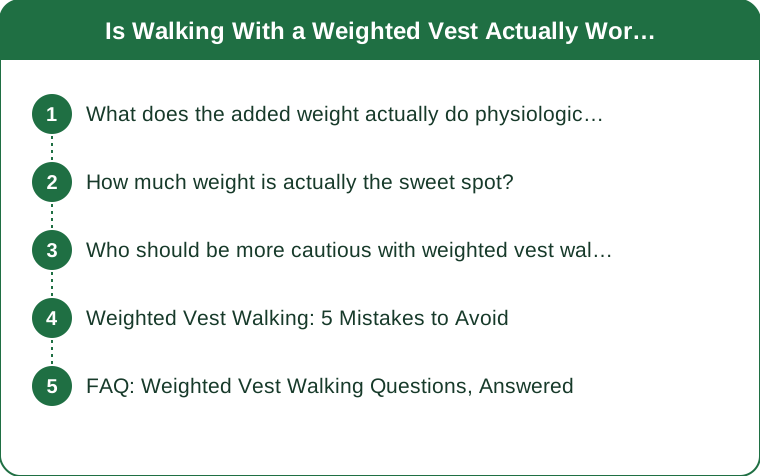
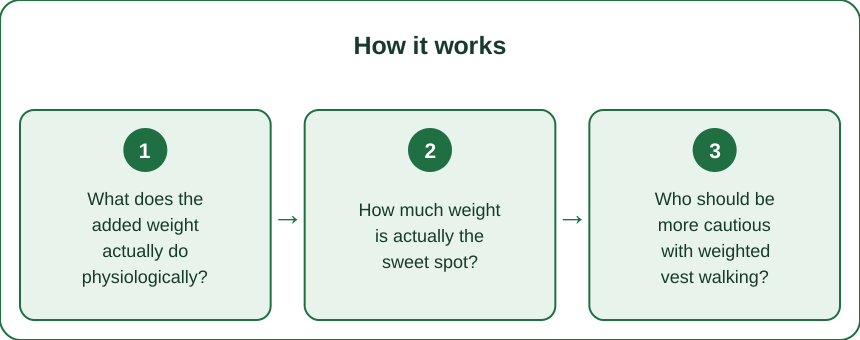
What does the added weight actually do physiologically?
A weighted vest increases the load your bones and muscles work against with each step, which can support bone density maintenance — genuinely useful for post-menopausal women and anyone concerned about bone health, since walking alone provides comparatively modest bone-loading benefit.
How much weight is actually the sweet spot?
5-10% of body weight is the range most commonly supported by research and trainers as providing meaningful benefit without excessive joint stress — for a 150 lb person, that’s roughly 7.5-15 lbs. Going beyond 10-15% significantly increases joint stress, particularly on knees and lower back, without proportionally more benefit.

Who should be more cautious with weighted vest walking?
Anyone with existing knee, hip, or lower back issues should start lighter than the general recommendation or skip it — added load compounds existing joint stress. Beginners to walking in general should build a base of unweighted walking first before adding load, since form under fatigue matters more with extra weight.
Weighted Vest Walking: 5 Mistakes to Avoid
1. Starting too heavy — begin at 5% body weight, not 10%, and increase gradually over weeks.
2. Wearing it on every single walk — some unweighted recovery walks reduce cumulative joint strain.
3. Ignoring new joint pain — this is a stop signal, not something to push through.
4. Poor vest fit — a vest that bounces or shifts changes your gait mechanics and increases injury risk beyond the weight itself.
5. Using it for speed walking or running — vests are generally better suited to walking pace; higher-impact activities amplify joint stress substantially.
FAQ: Weighted Vest Walking Questions, Answered
How often should I walk with a weighted vest?
2-4 times weekly is a reasonable starting frequency, with unweighted walks filling in the rest for joint recovery.
Does a weighted vest walk burn significantly more calories?
Yes, typically 5-15% more depending on weight percentage and pace — a modest but real increase, not a dramatic transformation.
Is a weighted vest safe for daily use?
For healthy joints at the 5-10% range, many people tolerate daily use fine, but alternating with unweighted days is a more conservative, joint-friendly approach.
TL;DR:
- 5-10% of body weight is the sweet spot for benefit without excessive joint stress
- Bone-loading benefit is the standout advantage, especially for bone density concerns
- Existing joint issues or walking-beginner status are reasons to start lighter or skip it
- Alternate weighted and unweighted walks rather than vesting every single session
See It in Motion
Seen here: Super High Waist Embossed Yoga Leggings with Inner Pocket — shop it on bubblelime.com
Keep Reading
This article is for general informational and styling purposes only. Fit, sizing, and product availability may vary.