Walking with a Stroller: Why It Feels Harder and Wrecks Your Posture
Quick Answer: Pushing a stroller raises the energy cost of walking meaningfully - studies of stroller walking have found notable increases in oxygen consumption and heart rate compared with walking unloaded at the same speed - while simultaneously encouraging a forward-leaning, rounded-shoulder posture that creates upper back and neck soreness. The three fixes are raising or adjusting the handle height, alternating one-handed pushing sides rather than favouring one, and deliberately walking taller with the stroller closer to your body.
It looks like a gentle walk. It reliably leaves your shoulders aching and your legs more tired than the distance justifies, and both of those have specific mechanical explanations.

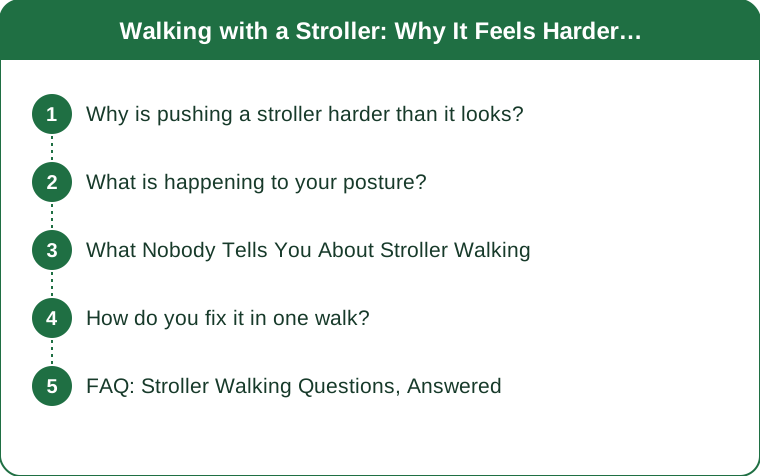
Why is pushing a stroller harder than it looks?
Three things stack.
You are doing external work. Pushing a loaded stroller means overcoming rolling resistance continuously. Research comparing stroller walking to unloaded walking at matched speeds has found substantial increases in oxygen uptake and heart rate - one commonly cited study found the metabolic cost rose enough to move a moderate walk into a meaningfully higher intensity bracket. So the extra fatigue is real, not imagined.
Your arms are occupied and your gait changes. Normal walking uses contralateral arm swing - opposite arm to leading leg - which is a genuine contributor to efficiency and rotational balance. Holding a stroller removes it entirely. Your trunk then has to stabilise rotation without the arm swing helping, which costs energy and loads the mid-back differently.
Your posture shifts forward. Most stroller handles sit lower than is ideal for an adult, which pulls the shoulders forward and rounds the upper back. Held for forty minutes, that is a sustained isometric load on muscles that are not built for sustained isometric loads.
Terrain multiplies all of it. Grass, gravel, and any uphill dramatically increase rolling resistance. A pram on a gravel path is a substantially harder workout than the same pram on smooth pavement, which is why some routes feel wildly harder than their distance suggests.
And the load is not trivial. A toddler plus a bag plus the stroller itself frequently exceeds 20 kilograms, which is a meaningful resistance to push continuously for several kilometres.
What is happening to your posture?
A predictable pattern, and the soreness locations map onto it exactly.
Handle height is the primary variable. A handle below your natural relaxed hand position pulls the shoulders down and forward and encourages the chest to collapse. The upper trapezius and levator scapulae then work continuously to hold the head against gravity in a forward position, which is why the ache lands at the top of the shoulders and base of the neck.
The forward lean adds lumbar load. Leaning into the push - which everyone does on hills - moves the trunk’s centre of mass forward and increases demand on the lower back extensors. Over a long walk this is where lower back tiredness comes from, not from the walking.
One-handed pushing creates asymmetry. Pushing with one hand while holding a coffee, a phone, or a second child’s hand loads one side of the trunk continuously. Done habitually on the same side - and nearly everyone has a default side - it produces one-sided neck and mid-back tightness over weeks.
Wrist position matters more than expected. Many handles force a pronated, wrist-extended grip. That position, held for an hour, contributes to forearm and wrist discomfort in the same way a poorly set up desk does.
The tell-tale pattern: soreness in the upper traps and between the shoulder blades after stroller walks, and not after unloaded walks of the same distance, is a handle height and posture issue rather than a fitness issue.

What Nobody Tells You About Stroller Walking
It is a legitimately good workout if you let it be. The added metabolic cost means a stroller walk at a moderate pace can sit in a genuinely useful intensity range. Many people mentally file it as not counting, which is both inaccurate and demotivating. It counts.
Alternating hands does more than any stretch. Switching which hand pushes - and switching regularly, every few minutes, not just when one arm tires - prevents the asymmetric loading that causes most one-sided stroller soreness. It feels awkward for a week and then does not.
Adjustable handle height is worth prioritising when buying. Fixed-height handles are set for an average that fits relatively few people. If you are notably tall or short, a fixed handle is a daily posture compromise for years.
Uphill is where technique matters most. The instinct is to lean into the handle with straight arms and a rounded back. The better pattern is to keep the trunk upright, bring the stroller closer to the body, bend the elbows slightly, and drive from the legs - the same principle as pushing a sled properly.
Bigger wheels genuinely reduce effort on rough surfaces. Rolling resistance falls with wheel diameter and rises sharply on soft ground. A jogging-style stroller on a gravel path is dramatically easier to push than a compact-wheeled city model, which is a real consideration if your regular route is not paved.
How do you fix it in one walk?
Three adjustments, all free, all immediate.
1. Fix the handle relationship. If the handle adjusts, set it so that with relaxed shoulders and slightly bent elbows your hands fall naturally onto it - roughly between navel and lower ribs for most people. If it does not adjust, compensate by walking closer to the stroller rather than reaching forward for it. The distance from your body is something you control even when the height is not.
2. Walk tall, and check three points. Every few minutes, run a quick audit: are my shoulders down and back rather than up and forward; are my elbows bent rather than locked straight; is my head over my shoulders rather than in front of them. Three seconds, and it resets the pattern before soreness accumulates.
3. Alternate hands on a schedule. Not when you notice fatigue - by then the asymmetry has already been loaded. Switch at every crossing, every corner, or every song, whichever is easiest to remember.
And to make it a better workout rather than just a less painful one:
- Pick a route with hills, which turns rolling resistance into a genuine strength stimulus.
- Use intervals - two minutes brisk, two minutes easy - which is easier with a stroller than without because the resistance is constant.
- Add a few sets of walking lunges pushing the stroller ahead of you on a quiet stretch, which is a surprisingly effective loaded lunge.
- Finish with two minutes of doorway chest stretch and a few sets of shoulder blade squeezes at home, which directly counteracts the position you just held for an hour.
FAQ: Stroller Walking Questions, Answered
Is pushing a stroller good exercise?
Yes. Studies comparing stroller walking with unloaded walking at the same pace have found meaningful increases in oxygen consumption and heart rate, so the same route at the same speed is a harder session with a stroller than without.
Why do my shoulders hurt after walking with a stroller?
Usually handle height. A handle lower than your relaxed hand position pulls the shoulders forward and rounds the upper back, loading the upper trapezius isometrically for the length of the walk. Raising the handle or walking closer to the stroller addresses it.
Should I push a stroller with one hand or two?
Two is better for symmetry and posture. If you need a hand free, alternate sides frequently rather than defaulting to the same one, since habitual one-sided pushing produces one-sided neck and mid-back tightness over time.
How fast should I walk with a stroller?
Whatever pace lets you maintain upright posture and talk in short sentences. Because the metabolic cost is higher, a pace that feels moderate with a stroller is a genuinely useful training intensity - there is no need to match your unloaded walking speed.
TL;DR:
- Pushing a loaded stroller measurably raises oxygen cost and heart rate - it counts as a real workout.
- Losing arm swing and pushing against rolling resistance explains the extra leg fatigue.
- Shoulder and neck ache comes from handle height, not from the walking.
- Walk closer to the stroller, keep elbows bent, and alternate pushing hands on a schedule.
- Hills and intervals turn it from a chore into a genuinely effective session.
It is not a lesser walk. It is a loaded carry with a toddler in it, and treating it that way makes it both more comfortable and more useful.
See It in Motion
Seen here: High Waist Jogger Sweatpants with Pockets — shop it on bubblelime.com
Keep Reading
This article is for general informational and styling purposes only. Fit, sizing, and product availability may vary.