Is Walking the Same Route Every Day Actually Bad for You?
Quick Answer: Physically, walking the same route daily is fine — your body doesn’t need route variety for cardiovascular benefit. The real cost is mental: familiar routes can dull engagement and make the habit feel like a chore over months, which is a consistency risk more than a fitness one.
There’s a quiet assumption that variety is always better for exercise. For walking specifically, the same route every day isn’t holding your fitness back — but it might be quietly eroding your motivation to keep showing up.

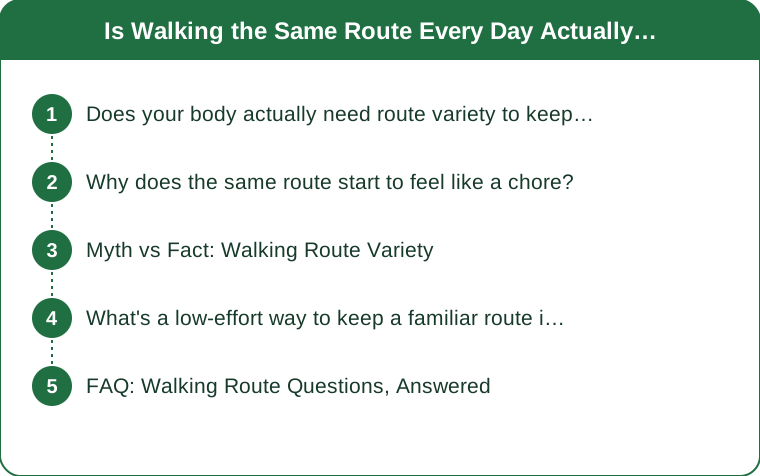
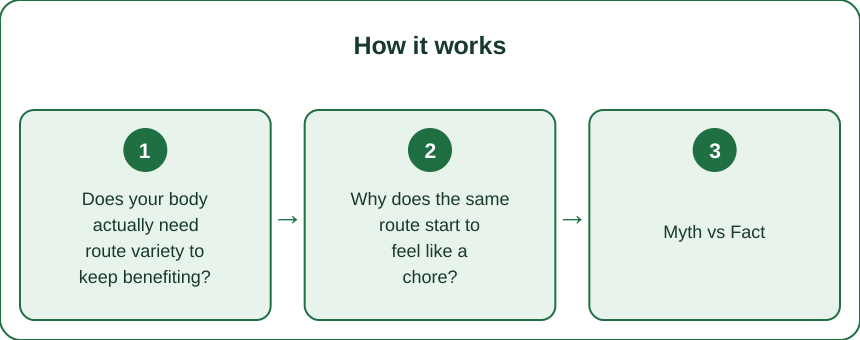
Does your body actually need route variety to keep benefiting?
No — the cardiovascular and mood benefits of walking come from the movement itself, not the scenery. A familiar flat loop provides the same heart-rate benefit on day 200 as day 1.
Where variety helps physically is incline and terrain — mixing in hills or uneven ground occasionally engages stabilizer muscles a flat familiar route doesn’t.
Why does the same route start to feel like a chore?
Novelty drives dopamine, and a route your brain has fully mapped stops providing the small mental engagement that made early walks feel refreshing.
This is a habit-adherence risk, not a fitness one — people are more likely to skip a walk that’s become mentally flat than one that still holds some interest.

Myth vs Fact: Walking Route Variety
Myth: You need to change your walking route regularly for fitness results. Fact: Physical benefit is nearly identical regardless of route familiarity — this is a motivation issue, not a training one.
Myth: A familiar route means you’re not working hard enough. Fact: Effort is about pace and duration, not novelty — a familiar route at a brisk pace is still real cardio.
Myth: Podcasts and music can’t fix route boredom. Fact: Audio content is one of the most effective ways to keep a familiar route mentally engaging without changing the physical route at all.
What’s a low-effort way to keep a familiar route interesting?
Rotate audio content (a new podcast episode, an audiobook chapter reserved only for walks) rather than the physical route itself — this preserves the convenience of a known path while refreshing the mental experience.
Alternating direction (walking the loop clockwise vs. counterclockwise) is another near-zero-effort way to make a familiar route feel subtly different.
FAQ: Walking Route Questions, Answered
Is it bad to walk the exact same route every single day?
Not physically — the main risk is boredom leading to skipped walks over time, which is solvable without actually changing the route.
Does walking the same flat route limit fitness progress?
For cardiovascular benefit, no; for building strength in stabilizer muscles, occasional hills or varied terrain add something a flat route doesn’t.
How often should I actually change my walking route?
There’s no required frequency — change it only when boredom starts threatening consistency, and audio variety often solves that without a route change at all.
TL;DR:
- Same-route walking is physically just as effective as varied routes for cardio benefit
- The real risk is motivation, not fitness, as familiar routes lose mental engagement over months
- Occasional hills or varied terrain add stabilizer-muscle benefit a flat route doesn’t
- Rotating audio content is a low-effort fix that doesn’t require changing the route at all
If the route still gets you out the door, it’s working — the only signal to actually change it is losing interest in showing up.
See It in Motion
Seen here: Super High Waist Embossed Yoga Leggings with Inner Pocket — shop it on bubblelime.com
Keep Reading
This article is for general informational and styling purposes only. Fit, sizing, and product availability may vary.