The Walk-and-Listen: Pairing Podcasts With Your Daily Miles
Quick Answer: Pair routes to episode runtimes — a 30-minute loop for a news show, a 50-minute path for an interview — so the walk ends when the episode does and you never check the time. Save one serialized show exclusively for walks; wanting the next episode is what gets the shoes on tomorrow. Keep one walk a week bare-eared.
There are two kinds of daily walker.
The first checks the distance every four minutes. The second looks up surprised to find they’ve walked five kilometers because the episode was too good.
The second kind has found walk-audio pairing — the habit fuel nobody budgets for and everybody could use.

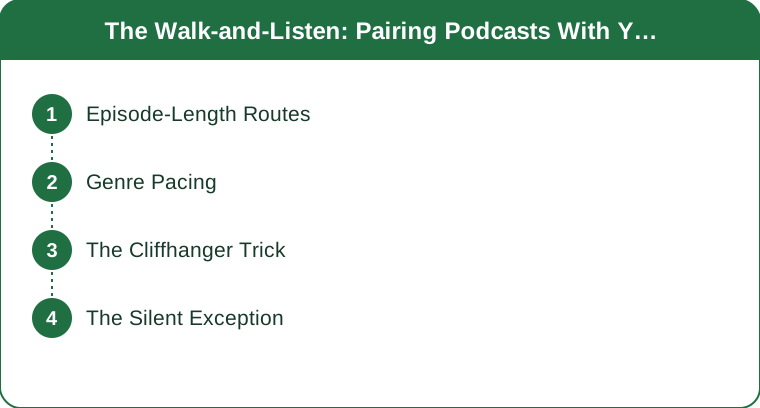
How Do You Match a Route to an Episode?
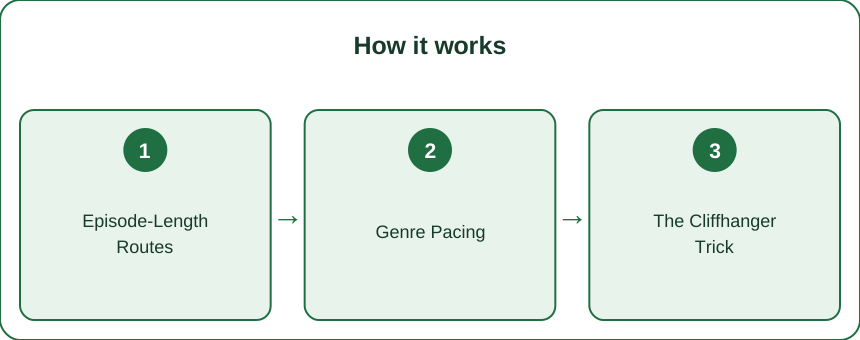
By runtime, not by distance.
The 30-minute neighborhood loop pairs with a daily news show. The 50-minute river path pairs with a long-form interview. The 20-minute errand walk pairs with a short comedy episode.
The route ends when the episode ends. The watch never gets consulted, and the walk never feels long — which is the entire trick, because “how much further” is what kills walking habits.
Practical setup: build a short list of three routes at three durations, and know roughly which shows fit each. Once that mapping exists, the daily decision collapses to “which one do I feel like,” which is a much easier question than “should I go.”
Does the Genre Actually Change Your Pace?
Yes, noticeably.
True crime walks fast — the suspense quickens your steps without you deciding to. Comedy strolls; it’s hard to march while laughing. Heavy documentary suits a gentle recovery loop where you’re not trying to push.
Music does this even more directly: faster tempo tends to pull cadence up with it, which is why a 150-bpm playlist and a 90-bpm one produce different walks on the same route.
So match the genre to the intended effort and the pacing largely handles itself. Brisk day, put on something tense. Recovery day, put on something slow.

What’s the Cliffhanger Trick?
Save one serialized show exclusively for walks. No listening in the car, no listening while cooking, no exceptions.
That’s the rule with teeth. Wanting to know what happens next converts directly into tomorrow’s shoes going on, and it works whether or not you feel like walking — which is precisely the day it needs to work.
Behavioral researchers call this temptation bundling: pairing something you should do with something you want, so the wanting does the scheduling. The published work on it found people showed up more consistently when the tempting audio was only available during the activity.
Walkers call it “just one more lap.”
A serialized show works far better than a standalone one here, because a cliffhanger is a stronger hook than a good episode.
Should Every Walk Have Audio?
No — keep one a week bare-eared.
Birds, traffic, your own thoughts, actual life audio. The phoneless walk is a different tool doing a different job: the podcast builds the streak, the silence builds the sanity.
There’s a practical argument too. Constant audio input means you never let your mind wander, and mind-wandering is where a lot of people’s problem-solving quietly happens. A complete walker carries both modes.
Also: at least one walk a week with full hearing is a reasonable safety practice if any part of your route shares space with cars or bikes.
5 Mistakes Everyone Makes
- Both earbuds in near traffic. Use one, or use bone-conduction headphones. Your route probably has more cars in it than you think.
- Letting the exclusive show leak. One “I’ll just listen while I do the dishes” and the hook is gone. The rule only works if it’s absolute.
- Downloading nothing. Dead zones and dead data plans end walks. Download the episode the night before.
- Choosing the route first. Pick the episode, then the route that fits it. That order gets you out the door faster.
- Never walking in silence. The streak matters, but so does the head-clearing. One a week, minimum.
FAQ
What podcast length is best for a daily walk?
Whatever matches the route you’ll realistically do. For most people that’s 25–45 minutes, which covers roughly 2–3 miles at a normal pace — long enough to be a real walk, short enough to fit a weekday.
Does listening to something make the walk less beneficial?
Not physically. The cardiovascular and joint benefits are identical. What you trade is the mental quiet, which is why the one-silent-walk-a-week rule exists.
How do I stay safe with headphones on?
Use one earbud, or bone-conduction headphones that leave the ear canal open. Keep the volume low enough to hear a bike bell, and go bare-eared entirely on any stretch without a sidewalk.
What if I run out of episodes?
That’s a good problem — it means the habit is working. Keep a backup queue of two shows, and treat audiobooks as the overflow. A long book is arguably better than a podcast for this, because it never runs out mid-week.
TL;DR:
- Match routes to episode runtimes so the walk ends when the audio does
- Build three routes at three durations and map shows to them
- Genre sets pace: true crime walks fast, comedy strolls, documentary recovers
- Save one serialized show exclusively for walks — that’s temptation bundling, and it works
- Keep one walk a week with no audio at all
- One earbud or bone-conduction near traffic; download episodes the night before
- Pick the episode first, then the route
Route by runtime, genre by effort, cliffhangers held hostage, one silent day. The walk was always good for you — now it’s also the only place the next episode lives.
See It in Motion
Seen here: High Waist Yoga Leggings with Inner Pocket — shop it on bubblelime.com
Keep Reading
This article is for general informational and styling purposes only. Fit, sizing, and product availability may vary.