Walking on Sand vs Walking Hills: Why They Wreck You Differently
Quick Answer: Walking on soft sand costs roughly 1.6 to 2.5 times more energy than firm ground because each step loses energy to the sand deforming underfoot, and it heavily loads the calf, foot, and hip stabilizers. Hill walking raises energy cost through vertical work and loads the glutes, quads, and cardiovascular system. Sand produces more localized muscle soreness; hills produce more whole-body fatigue.
They are not interchangeable substitutes for each other, which matters if you are using one to train for the other.

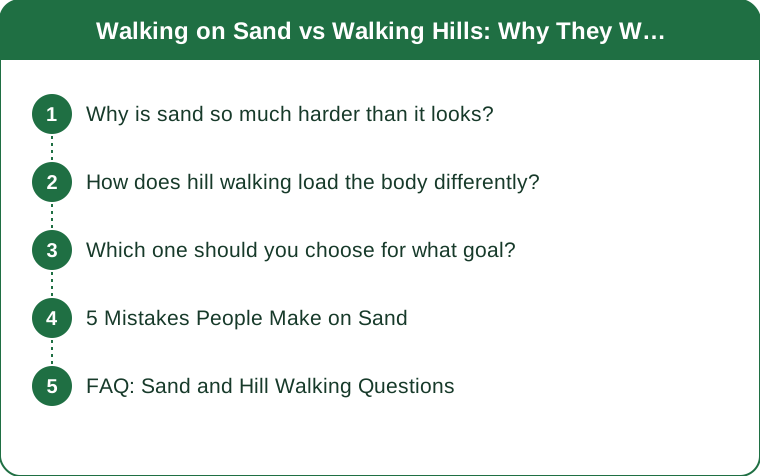
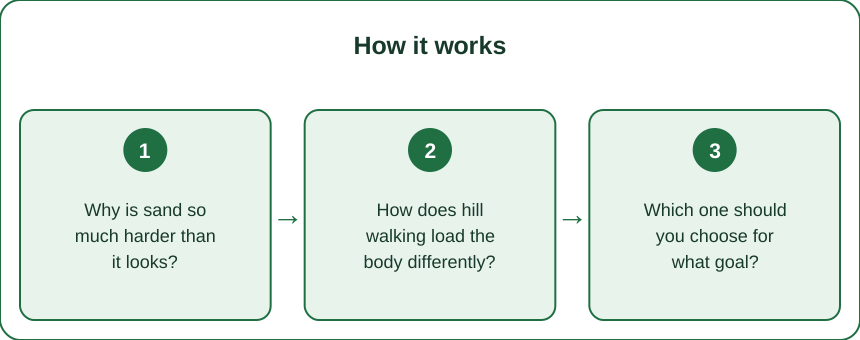
Why is sand so much harder than it looks?
Because a substantial fraction of every push-off is lost into the ground rather than moving you forward.
On firm ground, your foot and Achilles tendon act as a spring - energy stored during the loading phase returns during push-off, and this elastic recoil supplies roughly 30 to 40 percent of the energy of a walking step.
Soft sand deforms under the foot. The energy that would have gone into elastic storage goes into displacing sand grains, and none of it comes back. Studies measuring metabolic cost put walking on soft dry sand at roughly 1.6 to 2.5 times the energy cost of the same speed on a firm surface, with the highest values for the softest, driest sand.
There is a second effect. Because the surface shifts under you, the small stabilizing muscles of the foot, ankle, and hip work continuously to correct. That work is metabolically modest but produces disproportionate muscle soreness the next day, because those muscles rarely get loaded that way.
This is why an easy-feeling 30-minute beach walk can produce calf and arch soreness comparable to a much harder gym session.
How does hill walking load the body differently?
It adds vertical work, which is a straightforward and largely cardiovascular cost.
Raising your body mass against gravity has an unavoidable energy cost: roughly 9.8 joules per kilogram per meter of elevation, before accounting for efficiency. Walking up a 10 percent grade at a normal pace can nearly double your energy expenditure compared to flat ground.
The muscular load concentrates in the glutes and quadriceps, with the hip extensors doing most of the work at steeper grades. The calf works but in a different pattern than on sand - concentric drive rather than continuous stabilization.
Downhill is the part people underestimate. Walking downhill involves eccentric contraction of the quadriceps to control descent, and eccentric loading is the primary driver of delayed onset muscle soreness. A long descent produces more next-day quad soreness than the climb did.
Cardiovascularly, hills push heart rate higher and more continuously than sand does at the same perceived effort, because the vertical work is sustained rather than intermittent.

Which one should you choose for what goal?
It depends on which adaptation you want, and the answers are fairly distinct.
For cardiovascular fitness: hills. Sustained elevated heart rate, easily progressed by changing grade or pace, and the effort is continuous rather than variable.
For foot and ankle strength: sand, clearly. The continuous stabilization demand strengthens the intrinsic foot muscles and the ankle stabilizers in a way that firm ground does not. This is genuinely useful for people prone to ankle rolls.
For calf and Achilles development: sand, but carefully. The load is high and the surface is unpredictable, which is exactly the combination that produces Achilles problems if you ramp too fast.
For joint-friendly training: sand, with a caveat. Soft sand reduces impact loading substantially, which is helpful for knees. But the uneven surface increases lateral stress at the ankle and knee, so it is not universally gentler.
For weight management: either, and the higher cost of sand means less time for equivalent expenditure. Thirty minutes on soft sand is roughly comparable to fifty on flat firm ground.
One combination worth knowing: walking on wet packed sand near the waterline gets you most of the surface variability with much less of the energy penalty, which makes it a good middle option and a good place to start.
5 Mistakes People Make on Sand
-
Starting with soft dry sand. The dry stuff at the top of the beach is the hardest surface there is. Start on wet packed sand near the water and progress upward over several weeks.
-
Going barefoot immediately. Barefoot sand walking is excellent for foot strength and it is also how people develop plantar fascia problems. Ten to fifteen minutes for the first few sessions is plenty.
-
Ignoring the camber. Beaches slope toward the water, so walking parallel to the shoreline puts one leg permanently higher than the other. Over a long walk this creates asymmetric hip and knee loading. Turn around halfway so each leg spends equal time on the high side.
-
Treating it as an easy walk. Sand at 1.6 to 2.5 times the energy cost is a training session, not a stroll. It deserves the same warm-up and progression respect as any hard session.
-
Doing it the day before something important. The calf and foot soreness from unfamiliar sand walking peaks at 24 to 48 hours and can genuinely affect a run or a race.
The camber one catches almost everyone, and it is the most likely of the five to produce an actual injury over a summer of beach walking.
FAQ: Sand and Hill Walking Questions
Does sand walking burn significantly more calories?
Yes - roughly 1.6 to 2.5 times as much as the same duration on firm flat ground, depending on how soft the sand is. That is a large difference, comparable to adding a substantial hill.
Is walking on sand good for plantar fasciitis?
It can go either way. The soft surface reduces impact, but the extra work demanded of the arch can aggravate an already irritated fascia. If you have active symptoms, wet firm sand in supportive shoes is a safer place to start than barefoot dry sand. This is general information, not medical advice.
Can I train for hilly hiking by walking on sand?
Partly. You will build the foot, ankle, and calf capacity, and the cardiovascular base. You will not build the specific eccentric quad tolerance that long descents require, and that is what causes most hiking soreness. Add downhill walking if you can find any.
TL;DR:
- Soft sand costs 1.6 to 2.5 times more energy than firm ground because elastic energy return is lost to the deforming surface.
- Sand loads calves, feet, and stabilizers, producing localized soreness; hills load glutes and quads and drive cardiovascular demand.
- Downhill walking is the main source of quad soreness because it is eccentric work.
- Start on wet packed sand, limit early barefoot sessions, and turn around halfway to balance the beach camber.
- Thirty minutes on soft sand is roughly comparable in cost to fifty minutes on flat firm ground.
Late summer is the last comfortable stretch for beach walking in most places - a good moment to build foot strength before the routine moves indoors. This is general information, not medical advice.
See It in Motion
Seen here: Super High Waist Embossed Yoga Leggings with Inner Pocket — shop it on bubblelime.com
Keep Reading
This article is for general informational and styling purposes only. Fit, sizing, and product availability may vary.