Why Walking Backwards for 5 Minutes a Day Might Fix What Forward Walking Can't
Quick Answer: Walking backwards (retro walking) activates your quadriceps far more than forward walking, reduces the compressive load on your knee joint, and forces small stabilizing muscles in your ankles and hips to work overtime — which is why physical therapists have used it for decades, even though it looks a little odd at the gym.
You’ve probably seen someone walking backwards on a track and assumed it was a quirky habit. It’s actually one of the most studied low-impact exercises for knee health, and it takes almost no equipment to try.

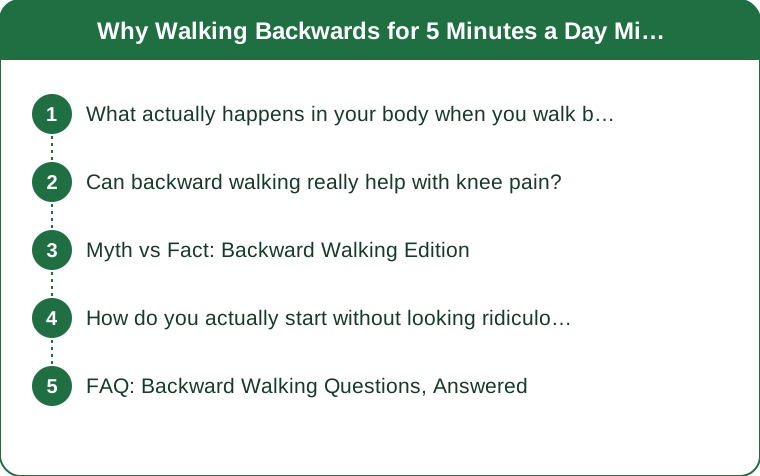
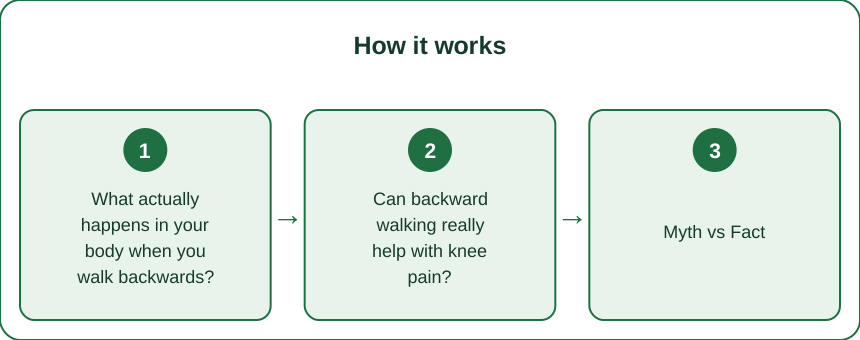
What actually happens in your body when you walk backwards?
Reversing your stride shifts the workload from your hamstrings and glutes (dominant in forward walking) to your quadriceps, which have to control your knee through a completely different range of motion. Your ankles and hips also fire more stabilizer muscles since you can’t see where you’re stepping, which is why your first few sessions will feel wobblier than expected.
Studies on retro walking consistently show lower peak knee compression forces compared to forward walking at the same speed, which is exactly why it shows up so often in rehab programs for knee osteoarthritis and post-injury recovery.
Can backward walking really help with knee pain?
For many people with mild knee osteoarthritis or anterior knee pain, yes — the reduced compressive load combined with strengthened quads can mean less pain during daily forward walking over several weeks. It’s not a cure, and it won’t fix a structural issue like a torn meniscus, but as a low-impact strengthening tool it has real research behind it.
Start with 2-3 sessions a week, 5-10 minutes each, on a flat, obstacle-free surface — a track or treadmill (at 1-1.5 mph, holding the rails at first) works best.

Myth vs Fact: Backward Walking Edition
Myth: It’s just a gimmick with no real benefit beyond forward walking. Fact: The quad activation and reduced knee compression are measurably different from forward walking — it’s not the same exercise in reverse, it’s a genuinely different loading pattern.
Myth: You’ll definitely fall or twist an ankle. Fact: On a treadmill at slow speed or a clear track, the risk is low — the wobbliness fades within a week or two as your proprioception adapts.
Myth: It burns way more calories than forward walking. Fact: The calorie difference is minor. The real value is joint mechanics and balance training, not extra burn.
How do you actually start without looking ridiculous at the gym?
The treadmill is genuinely the easiest entry point — set it to 1-1.5 mph, hold both side rails, and glance over your shoulder every few steps rather than craning your neck the whole time. Most people feel noticeably more coordinated by their third session.
Outdoors, pick an empty track lane or a straight, flat sidewalk stretch you already know well. Skip retro walking entirely if you have significant balance issues, vertigo, or an acute knee injury — check with a physical therapist first in those cases.
FAQ: Backward Walking Questions, Answered
Is backward walking safe for older adults?
Generally yes, and it’s often specifically prescribed in balance-training programs for older adults — but it should start on a treadmill with rail support or with a supervised session first.
How long until you notice a difference in knee comfort?
Most people who stick with 2-3 short sessions weekly report a noticeable difference within 3-4 weeks, though this varies with the underlying cause of the knee discomfort.
Can you combine backward walking with regular walks?
Yes — a common approach is finishing a normal walk with 5 minutes of backward walking on a flat stretch, which is an easy way to build the habit without adding a separate workout.
TL;DR:
- Backward walking shifts load to your quads and lowers knee compression forces versus forward walking
- Start on a treadmill at 1-1.5 mph holding the rails, 2-3 sessions a week
- It’s a strengthening and balance tool, not a calorie-burn upgrade
- Most people adapt within a week and see knee-comfort changes in 3-4 weeks
This is general information, not medical advice — check with a physical therapist if you have an existing knee condition before starting.
See It in Motion
Seen here: High Waist Jogger Sweatpants with Pockets — shop it on bubblelime.com
Keep Reading
This article is for general informational and styling purposes only. Fit, sizing, and product availability may vary.